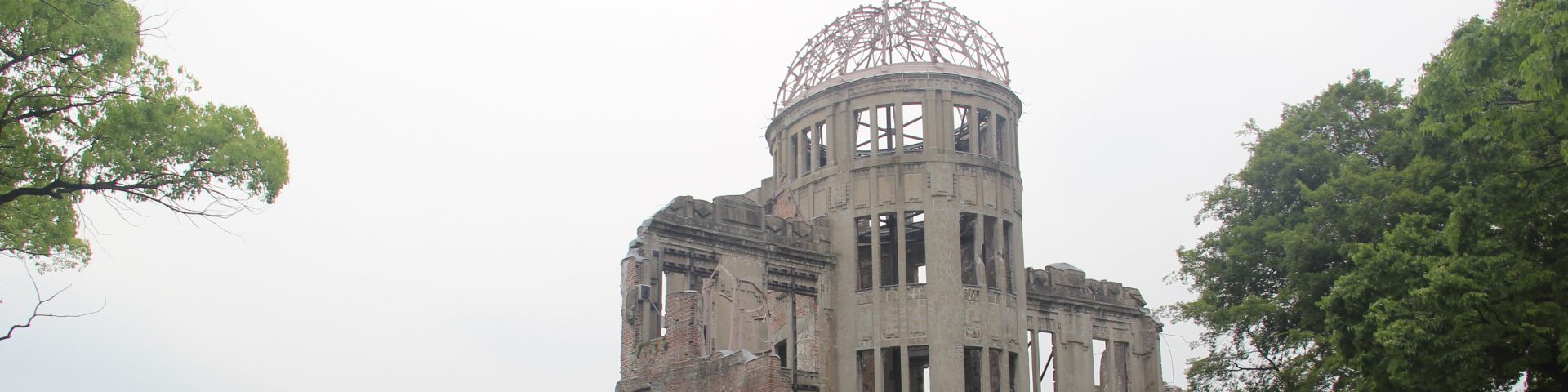
As soon as I arrived in Hiroshima, I dropped my bag off and headed straight for the Hiroshima Peace Memorial Park, a very different World Heritage Site than the one I had visited just that morning. It is interesting how we often use words to signify something that we don’t have but that we want. In a place where such destruction took place and where such pain had occurred, we call it “peace.” I understand the intention.
The Peace Park is a massive park which takes up most of the island in the center of the city. The first atomic bomb used against a civilian target detonated almost directly above the park on August 6, 1945. The intended target was a T-shaped bridge at the northern end of what is today the Peace Park, but the bomb drifted slightly during its descent and exploded above a medical clinic a block away.
In the park today, at least on a week day, you’ll see hundreds of Japanese middle school students. My friend had told me that essentially everyone in Western Japan (Ōsaka and beyond) will visit either Hiroshima or Nagasaki during their school years and the number of students in the area was remarkable. Unfortunately, about half of the museum and many of its exhibits were closed when I visited because the museum is under renovation. But the exhibits that I was able to see were remarkable.
Anyone who visits Hiroshima (or Nagasaki I assume as well) is left with a sickening realization of what we are capable of doing to each other. One hopes that we are able to avoid these weapons in the future, even as Donald Trump and Kim Jong Un seem hell-bent on testing them once more. It’s shocking to see the melted earth and ceramics as well as the other signs of nuclear destruction in the museum.
I wandered through the park and up to the A-Bomb Dome, which was called the Hiroshima Prefectural Industrial Promotion Hall at the time of the bombing. The structure was half-flattened in the blast and remains that way until today. This particular building marks the actual World Heritage Site and the only remaining standing symbol of the destruction (everything else is in the museum or re-built).
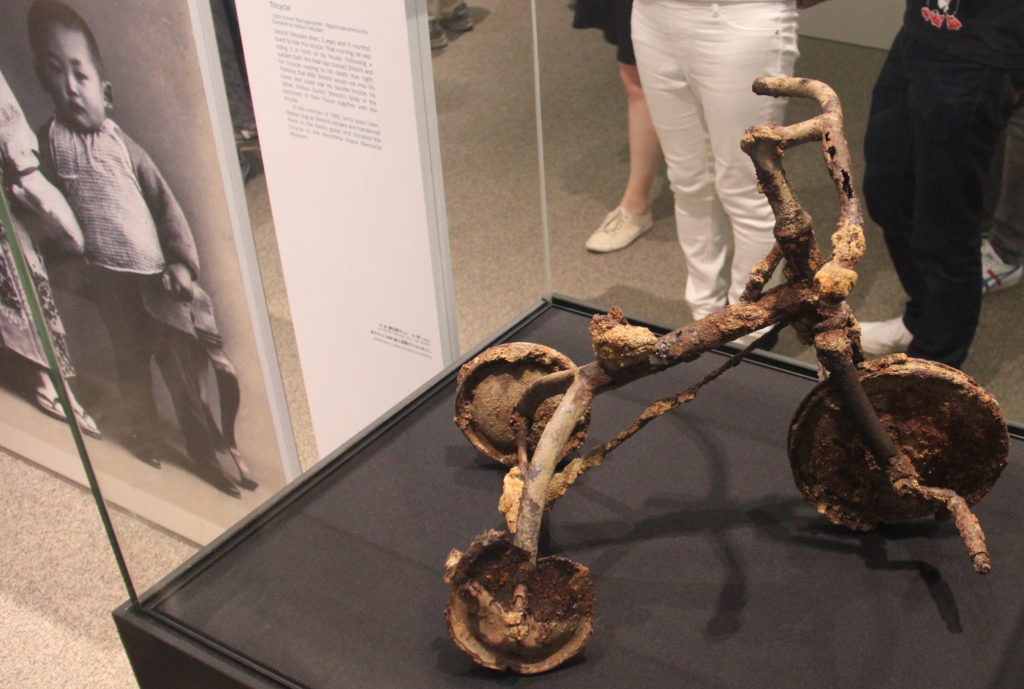
One of the museum artifacts that touched me most deeply was a little boy’s tricycle (likely because I have my own son and daughter who love their own tricycle)
Shin’s Tricycle (伸ちゃんの三輪車)
Exposed 1,500m from the hypocenter, Higashi-hakushima-cho Shinichi Tetsutani (鉄谷伸), then 3 years and 11 months, loved to ride this tricycle. That morning, he was riding in front of his house when, in a sudden flash, he and his tricycle were badly burned. He died that night. His father felt he was too young to be buried in a lonely grave away from home, and thinking he could still play with the tricycle, he buried Shinichi with the tricycle in the backyard.
In the summer of 1985, forty years later, his father dug up Shinichi’s remains and transferred them to the family grave. This tricycle, Shinichi’s best friend, was donated to the Peace Memorial Museum.
Shin and his older sisterShin’s Tricycle
After walking around the A-Bomb Dome and sitting next to the river for a while, I wandered the block over to the hypocenter, or the point over which the bomb exploded. Interestingly, the medical clinic that was there in 1945 was rebuilt after the war and remains there today.
Hiroshima City (広島市)
Earlier in the day when I had arrived in Hiroshima, I had noticed how new the Station looked. All train stations in Japan are relatively well kept (for mass transit) and mostly modern, but this station was very new looking. It seemed like half of the station was bring rebuilt as I walked through it. On the tram from the station to my hotel (a capsule hotel for the first time!), it was crowded with students making their way to the Peace Park. Hiroshima is a mostly modern city (the whole thing was reset in 1945), but not that remarkable outside of the Peace Park area. It was comfortable and nice, with a beautiful river running through the middle, but seemed quite comparable to the other cities in the region.
After finishing at the Peace Park area, I headed out to look for okonomiyaki (お好み焼き: what you like on the grill), a dish for which Hiroshima is well known. At one point, as I walked down the street, I noticed that the sun looked very odd (picture below). It was both beautiful and haunting to see the sun morphed into an odd non-circular shape by the clouds, but haunting and beautiful is how I can best describe Hiroshima. The okonomiyaki I found was delicious and well worth the search.
Capsule Hotels
I do have to write a small paragraph to fully describe the capsule hotel experience. Before staying in one, I was a bit curious, but assumed it was more like a coffin with a microwave door. Maybe some of them are like that, but the one I stayed in was actually perfect for what I needed: a clean and quiet place to sleep. The capsule hotel that I stayed at had different floors for each gender, lockers for your bags, common break areas, shared (but walled-off) showers, and a sink area. The capsules themselves were comfortable, with small lights and chargers inside the capsule for necessary electronics. It was basically 3 feet or so tall with a super twin sized bed inside. The door didn’t fully lock, but was more like a mini sliding garage door. Overall, I was impressed. I slept very well that evening after a long week of exploring. But I wasn’t quite done yet!
Every website on earth uses cookies to improve your experience on the web. By browsing this site and the internet in general, you consent to travel with cookies or resolve it through plug-ins on your own.
Cookie Preferences
Manage your cookie preferences below:
Essential cookies enable basic functions and are necessary for the proper function of the website.
Name
Description
Duration
Cookie Preferences
This cookie is used to store the user's cookie consent preferences.
30 days
These cookies are needed for adding comments on this website.
Name
Description
Duration
comment_author_url
Used to track the user across multiple sessions.
Session
comment_author
Used to track the user across multiple sessions.
Session
comment_author_email
Used to track the user across multiple sessions.
Session
Statistics cookies collect information anonymously. This information helps us understand how visitors use our website.
Google Analytics is a powerful tool that tracks and analyzes website traffic for informed marketing decisions.
Used only with old Urchin versions of Google Analytics and not with GA.js. Was used to distinguish between new sessions and visits at the end of a session.
End of session (browser)
__utmz
Contains information about the traffic source or campaign that directed user to the website. The cookie is set when the GA.js javascript is loaded and updated when data is sent to the Google Anaytics server
6 months after last activity
__utmv
Contains custom information set by the web developer via the _setCustomVar method in Google Analytics. This cookie is updated every time new data is sent to the Google Analytics server.
2 years after last activity
__utmx
Used to determine whether a user is included in an A / B or Multivariate test.
18 months
_ga
ID used to identify users
2 years
_gali
Used by Google Analytics to determine which links on a page are being clicked
30 seconds
_ga_
ID used to identify users
2 years
_gid
ID used to identify users for 24 hours after last activity
24 hours
_gat
Used to monitor number of Google Analytics server requests when using Google Tag Manager
1 minute
_gac_
Contains information related to marketing campaigns of the user. These are shared with Google AdWords / Google Ads when the Google Ads and Google Analytics accounts are linked together.
90 days
__utma
ID used to identify users and sessions
2 years after last activity
__utmt
Used to monitor number of Google Analytics server requests
10 minutes
__utmb
Used to distinguish new sessions and visits. This cookie is set when the GA.js javascript library is loaded and there is no existing __utmb cookie. The cookie is updated every time data is sent to the Google Analytics server.